
Process automation for SMEs: your 4-week roadmap
Start today.
The problem: in many SMEs, 80% of automation projects fail — not on the technology, but on missing structure, wrong priorities, and underestimated change management.
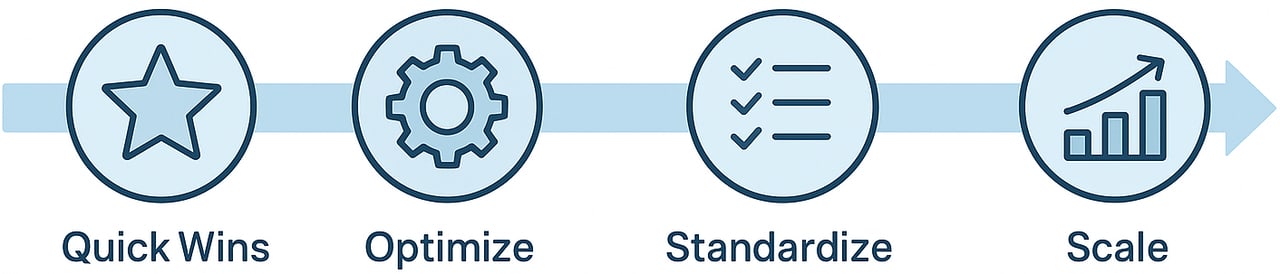
The solution: this 4-week roadmap takes you from quick wins in week 1 to stable, scalable workflows in week 4 — field-tested, lean, and measurable.
1. Planning in week 1: find and ship quick wins
Goal: build momentum and deliver visible results.
Day 1–2: process inventory
With your team, list the 10 most annoying, repetitive tasks:
– Copying data between systems (CRM → Excel → email)
– Manually sending standard emails/reports
– Duplicate data entry across multiple tools
– Status requests between departments
– Filing and renaming files
Day 3: impact vs. effort matrix
Score every task 1–5:
– Impact: hours saved per week
– Effort: time to go-live
Quick-win criterion: impact ≥ 4, effort ≤ 2
Day 4–5: ship your first automation
Tools: PowerAutomate (Microsoft), n8n (open-source).
Example: new leads from a website form → automatically into the CRM + notification to sales.
⏱️ Duration: 30 min 💰 Cost: €0–30 📊 Time saved: 2–3 hours/week 🎯 ROI: immediate
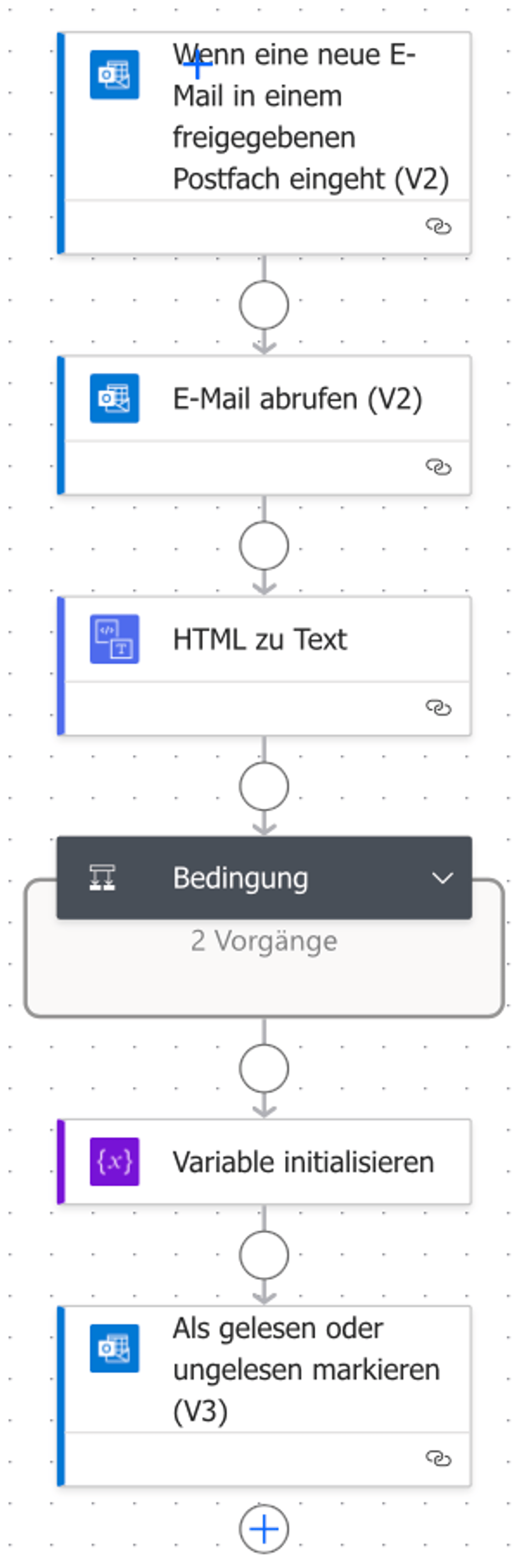
A PowerAutomate (Microsoft) flow processing emails automatically. This flow is completely free because we stay entirely within the Microsoft ecosystem.
2. Optimisation in week 2: data workflows & APIs
Goal: automate data flows, eliminate manual exports.
Typical automations:
– CRM ↔ Accounting: reconcile customer data/invoices
– E-commerce → Inventory: orders into the warehouse
– Time tracking → HR: hours synchronised
– Project tools → Reporting: dashboards/reports
Best practice: APIs, not CSVs.
Many SMEs export manually from A to B. It’s error-prone.
Modern solution: PowerAutomate and n8n connect APIs. Data flows in near real time. There are other automation tools too — make.com, Zapier. Always check that the infrastructure fits your company’s security model.
Mini-checklist “data quality”:
– Match on unique IDs, not names
– Document field mapping
– Validation (required fields, formats)
– Detect and resolve duplicates
– Review permissions & GDPR
3. Standardisation in week 3: quality and security
Goal: turn one-off solutions into reliable operating workflows.
Define roles & responsibilities
Assign an automation owner per workflow.
Duties: maintenance, monitoring, reporting, escalation.
Build in fault tolerance
Every flow needs a failure path:
– Retry logic (backoff)
– Fallback (email/task to the owner)
– Transparent logs (with IDs)
– Alerting (Slack/Teams)
Secure & document
– Permissions: principle of least privilege
– Secrets in a vault or app credentials — never in plaintext
– Version changes (PowerAutomate revisions, Git for n8n)
– Operational docs: purpose, trigger, fields, owner, SLA, rollback
Bring the team along
Communicate the what, the why, the benefit.
Show time saved before/after. Numbers motivate.
Avoid these classic pitfalls:
Starting too complex → pick 1–2 simple workflows first
No owners → assign one per workflow
No error handling → build a failure path
Team left out → explain and show early
No measurement → KPIs before/after
4. Scale in week 4: portfolio, monitoring & ROI
Goal: from “a few flows” → a scalable system.
Portfolio & priority: a workflow register with KPIs (volume, time saved, error rate, owner, SLA). Review impact/effort quarterly.
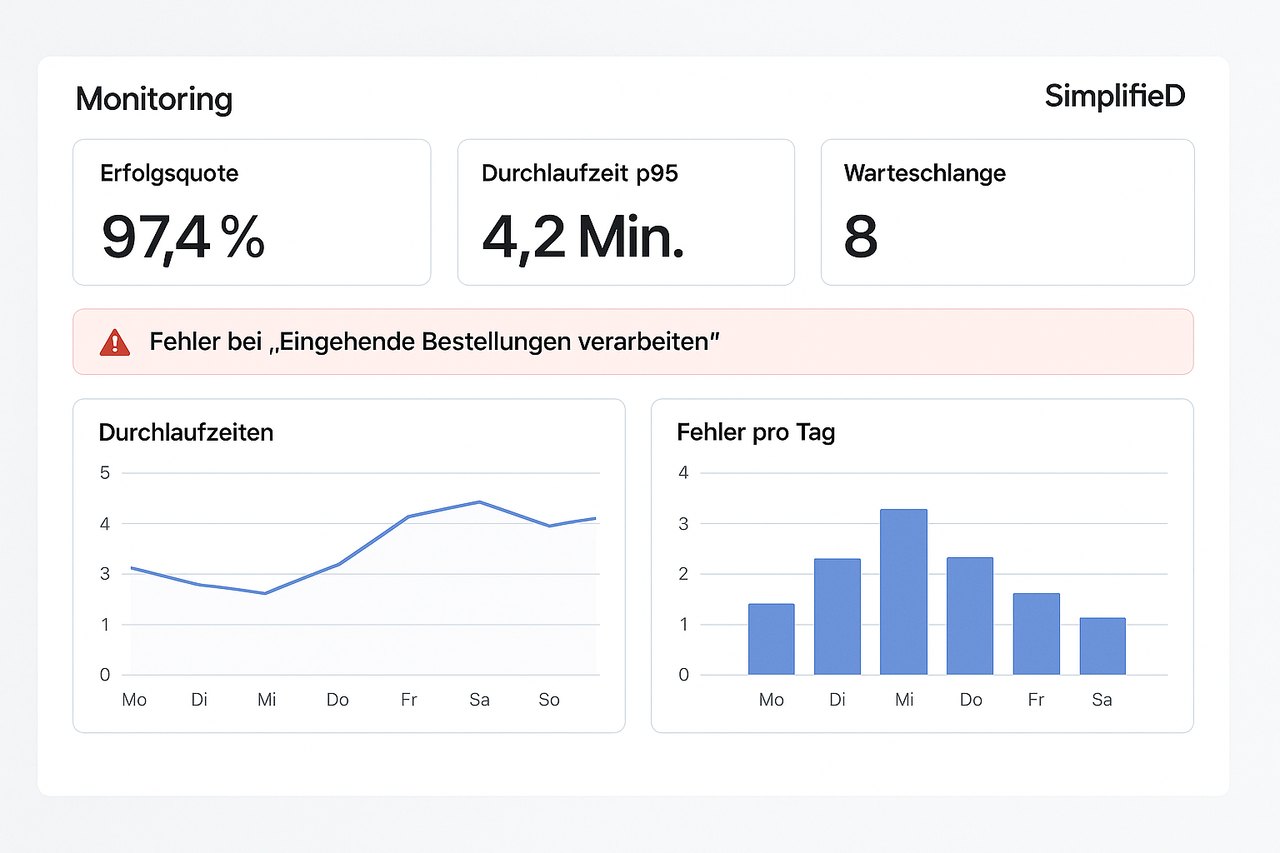
Monitoring & SLOs: dashboards (success rate, runtime, queue). Alerts (failures, latency, API limits). SLO: e.g. 99% ≤ 5 min.
Reusable building blocks: templates, naming conventions, schemas (lead/invoice/ticket), prompt library for AI steps.
Business case: ROI = (hours saved/month × €/hour) − (tool + ops cost) → < 3 months payback.
Next level: 5–10 flows live, AI (e.g. email classification), analytics (Power BI), your own APIs/low-code.
Takeaway
You now have a plan.
Week 1 delivers quick wins, week 2 stabilises data flows,
week 3 secures quality, security and adoption,
week 4 creates scale, monitoring and ROI.
That’s how SMEs avoid the typical pitfalls and save time immediately — with a structure that carries you long term. Automation isn’t a project, it’s continuous improvement. Start this week.